Se navezuje na info
It seems anything electric in our hobby these days is the hottest thing. With the continuous miniaturization of servos and receivers as well as advancing battery technologies, electrics are the hottest things at the flying field now a days.
Out west here in Calgary, Chuck Swaney and Gordon Gilchrist started an event called Fun400. This is an entry level electric pylon racing event. The prime objective of Fun400 is captured in the name. FUN ! It is born from the basic concept of traditional three-pole, ten lap pylon racing yet adapted to a much slower and smaller airplane. In the following article I will describe the attributes of this speed 400 entry level event.
Motor
A simple Speed 400, 6 volt motor with brushes. ie. not brushless. This is the same motor used in a Zagi or any other very inexpensive electric sport model. This motor is $6 or $7 US and they are made by the millions. It's certainly not high quality and a guy might get 30 or 40 races on one before the brushes wear out and it's time to install a new one. But what the heck, it's only 6 or 7 bucks. You don't want to get into brushless motors in an entry-level event because the price and performance rises rapidly. Further, you need a speed controller that can handle more amps and that’s more money as well.
Speed Controller
This is your throttle control. The speed controller is installed between the motor and the receiver. It plugs into the throttle port of the receiver. A very basic 15 or 20 amp speed controller is all that is required. The Speed 400 motor using an APC 5x5 prop draws about 12 to 13 amps. You need a speed controller that will handle at least this much current. These speed controls are easily available from the LHS or off the net. Cost is about $20.00 US.
Battery
Battery technology is advancing very quickly and any pylon event will be challenged by the temptation to chase the leading edge of the battery performance curve. This urge must be tempered. This is where the event could very quickly die as guys will destroy the event by trying to change the battery rule every six to twelve months as the latest technology comes out on the market. Currently the big rage is Lithium Polymer batteries but these are very expensive to purchase and to obtain a field fast charger that will charge them. My recommendation is to limit the entry level event to standard Nicad or Nickel Metal Hydride battery chemistry.
The event should specify a battery pack of maximum eight cells - Nicad or Nimh. Eight cells (9.6 volts) make the 6 volt motor come to life. The more voltage on the motor, the more rpm you get. However, there's a limit where you'll burn out the motor. I think 8 cells on a 6 volt motor is pretty much the limit. Hence the comment about burning out brushes after 40 races. A beginner could choose to run less cells with less rpm and the life of the motor will increase.
Cell capacity is the next consideration. The cells need to be 800 mah to 1100 mah for a decent pylon race. At full throttle, a 1000 mah, eight cell battery pack will fly about five minutes on a common race prop. This is drawing about 13 amps at full throttle. However, a ten lap pylon race only lasts the average pilot about two minutes. So a guy can use the same battery pack for racing as sport flying. Think of a typical Nicad discharge curve. You want to be still on the flat part of the discharge curve by the end of the race. You don't want to be falling off the back end of the curve while you're still on the course. There is a very popular Nimh cell right now called a KAN1050. This is 1050 mah. Very small, compact and light for the amount of power it puts out. "Power density" - watts per ounce of pack weight is very good for this Speed 400 pylon event. These packs can be purchased for about $25.00 US and are widely available. A guy will need at least two and preferably three packs to compete in a racing matrix. This allows time for cooling the pack down and re-charging.
Radio
Any typical computer programmable radio available today will work just fine. Mini servos and receivers are a must. I have got by using a Hitec 555 receiver and HS-55 servos - anything larger is generally too large. The price of this equipment is very reasonable and widely available. The KAN1050 battery above powers the receiver so there is no additional flight pack battery required. The speed controller discussed above has a special circuit in it that will shut down the motor when the available voltage in the pack gets low but not too low to continue to operate the receiver and servos. This is called a BEC (battery elimination circuit). The BEC allows you to land dead stick under full radio control.
Airframe
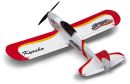
This can be the Achilles heel of the event. There will always be guys that want to design the latest go-fast, razor thin wing or airframe. Again, these guys need to enter an open brushless event to allow for their creativity in design. There are some very nice ARF kits on the market that are perfect for Speed 400 pylon events. The ones we have found most successful are the Ace Simple 400, Micron, and Twister. The kits range from $40.00 to about $120.00 US. The Simple 400 is a built up kit with foam wing and is very easy to build. The Micron and Twister are very much ARF with fiberglass fuselage. The Micron has a balsa-sheeted wing over foam but the Twister (most expensive of the three) has a composite wing with skinned hinges. I am currently most in favor of the Micron. It is the one I am racing. It is very easy to build (assemble) and quite rugged. I have abused mine a few times and it keeps on flying. Radar gun speeds with the setup discussed above are about 70 mph. Wing area is 150 sq. inches. Weight is 15 to 16 oz. The prop we use is an APC 5x5 electric prop. This has been found to be the best prop for the motor / plane setup. This airframe is easily hand launched and belly-landed. No landing gear. With only a little practice a guy can hand launch the model himself and easily fly away straight and level. In a race, usually the caller does the launching. See
http://www.soboxplanes.com for the Micron.
Race Course
A much smaller race course than traditional pylon racing is used. I think the course is similar to the old 1/2A course. We use a distance of 200' from base to pylon #1 and 60' across at #2 and #3. We fly ten laps from a hand launch start. The course needs to be shorter because the planes are much smaller than a Quickie or Q40. They get small and out of sight quickly.
Rules
There is no airtight set of rules for electric pylon yet. This is very much work in progress. One of my key mandates for the MAAC Pylon Committee is to come up with a good set of entry level pylon racing event rules as well as an Open Brushless event for the more experienced. I think our committee can do a good job. We have many experienced IC pylon racers as well as some electric guys and types like me that are active in both.
In electrics, the batteries are the biggest factor where advantage can be had. As mentioned, we limit the batteries to 8 cells and standard chemistry. We have found these to be very effective in combination with a handicap system described below. There are other electric pylon events raced in Canada. These involved a race to see who can do the most laps of the course in a set prescribed time. This is called Piker Pylon created about five years ago by Robert Pike of Southern Ontario. If you would like a copy of the Fun400 event rules email me and I would be happy to send you a copy.
I do think there is a need for the more advanced Open event that involves brushless motors, and specific airframe requirements. This would be more like a Quickie or Q40 type of event. We have yet to develop the brushless event in Canada yet. However, there are lots of Quickie and Q40 guys that want to give it a go in an Open brushless event. That's great. The beginners can have the entry level Fun400 and the experts will have a place to compete as well. Hopefully it will all work out so everyone is happy.
Go fast and turn left !
______________
In my last article I presented some basic equipment necessary to begin electric RC pylon racing. I covered airframes, power systems, a basic speed 400 motor and radio gear. However, while composing my next article for Smoothair.ca I realized that perhaps many of the readers are so new to pylon racing or any form of RC competition outside of a fun-fly that I might be making huge assumptions around what you, the reader, know or do not know. So perhaps it’s best to step back a little and provide a “Pylon Primer” from the ground up. No pun intended….
So what is pylon racing, how does it work, and what makes it exciting ? Have you ever been out at your local flying field and been in the air with one or more other pilots when you had the urge to chase them around the sky a little and perhaps even do a little dog-fighting. Did the ensuing chase turn into a bit of an end-to-end race around the field ? If so, you were on the verge of pylon racing. The only things missing were the poles and a little bit of disciplined flying.
A pylon race consists of two or more (usually four) pilots simultaneously controlling their aircraft around a race course defined by two or three poles or pylons. The course can be oval shaped defined by two poles or triangular in shape defined by three poles. The objective is for each pilot to fly a left-hand circuit around the outside of the poles completing ten laps. The first pilot to complete ten laps without cutting inside of the course defined by the poles is declared the winner. Judges are stationed outside the course and watch the flight path of each aircraft to ensure that it travels outside the poles. The race begins with all models either taking off from a hand-launch start towards the far #1 pylon or by way of a flying start similar to Reno style racing.
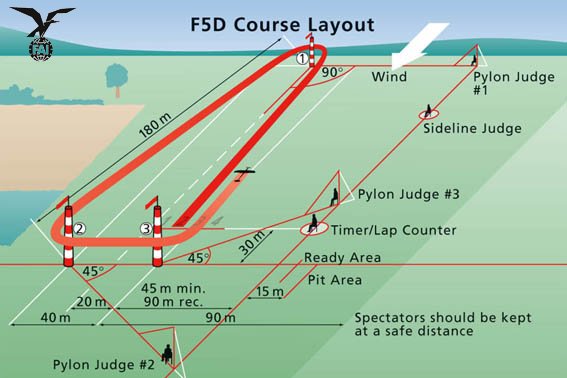
The pylon course can be of any defined length and width but there are established standard measurements proven to be successful based on general aircraft speed. The smallest course used is for basic speed 400 powered aircraft that fly between 50 and 80 mph. Based on a triangular course, the distance from the base pylons (or the bottom of the triangle) to the far pylon (or top of the triangle) is about 200 feet. The distance across the base, or from pylons #2 to #3, is 60 feet. For international competition, such as that in the F5D world championships, the course measures 590 feet to the far #1 pylon and 131 feet across the base from pylons #2 and #3. The F5D aircraft are approaching speeds of 180 mph. Each pylon is a minimum of 15 feet all and a maximum of 20 feet.
A Starter coordinates the organized launch or start of each aircraft for the race. The Starter’s decision, based on guidance from a defined set of event rules, is final and governs the activity of each pilot during the race. The Starter stands inside the race course and monitors the race from start to finish. The pilots also stand inside the race course and pilot their aircraft from any position within reasonable distance between the defined start line and the #2 and #3 base pylons. A set of judges and lap counters are positioned outside the course to monitor the flight path of the aircraft around the poles and to count laps for each pilot until he has completed ten laps. If any pilot flies inside of any pylon during the completion of the ten laps, a ‘cut’ is declared. The penalty for cutting one pylon is either a penalty lap or a defined penalty time added to the ten-lap time for the offending pilot. If any pilot cuts more than one pylon during his ten lap race, he is disqualified from that heat. Points are awarded for the completion of each race. First place receives four points, second place receives three points, third place two points, and fourth place one point. Any pilot who cuts more than one pylon or ‘cuts-out’ receive zero points. The winner of a pylon contest is the pilot with most number of heat points collected over a series of heats or rounds.
Due to the danger of frequency interference, no two pilots on the same radio frequency can compete against each other. For this reason, a frequency matrix is made up which defines which pilots will fly against each other in each heat. All attempts are made to have each pilot race against all other pilots not on his same radio frequency. In this way the best competition, and the most fun, is had by all.
So how does the pilot know when to turn at each pylon you ask ? Each pilot has a helper or ‘Caller’ that assists him as his second pair of eyes during the race. Because the pilot must focus on flying his aircraft and not take his eyes off of the plane to view the pylons, the Caller informs the pilot of his position on the race course and when to turn the far #1 pylon. But how does the Caller know when the model is beyond the far pylon you ask ? There is a judge or flagman situated off-course even with the far pylon pole. When each plane reaches the far pylon pole, the flagman raises a flag or flashes a light back at the Caller who is standing next to his pilot thus signaling that it is safe for the pilot to turn the model without incurring a cut. When the Caller sees the flag or light indication, he tells his pilot to “TURN!”. After a 180 degree turn, the model then proceeds back towards #2 pylon. The pilot and his Caller are standing close enough to pylons #2 and #3 that the pilot can easily judge when the model is outside of these pylons and fly a smooth arc around these pylons thus heading back towards #1 pylon again. With this, one lap is complete. The Caller then waits for the next signal from pylon #1 and calls “TURN !” once again.
Pylon racing is truly a team sport. It takes a skillful pilot and a sharp Caller to consistently win races. The two must communicate effectively with each other during the race and behave as one oiled machine guiding the model around each pylon for total of 30 turns in the shortest distance possible without cutting inside any pylon. This is all happening while two or three other pilot/caller teams are chasing you. Each wanting to be faster than you, fly a tighter course, or pressure you into a ‘Cut’. Add to this the risk of flying at low altitudes (30 feet or less) and mid-air collisions due to each pilot wanting to consume the same airspace, or best position around the polls, and you can see why pylon racing is exciting.
You might ask, “What’s so difficult about flying flat and level and turning left ?” Well, that in itself is not difficult for the average RC pilot. What is difficult, and what makes pylon racing so challenging, is to guide your model with precision and consistency around ten laps putting the plane exactly where you want it in the sky in preparation for each turn. A poor setup prior to any one pylon will result in a larger or longer course flown around the pole or perhaps a cut inside of the pole. For this reason, flying the plane with skill and precision and putting it in the exact position relative to the pylons is what makes it difficult. Some of the best pylon racers are actually former RC aerobatic or pattern pilots. This is because a pattern pilot has discipline in his flying and can put the model exactly where he wants it in the sky even when faced with windy weather conditions. A pilot who simply goes out each time he flies and bores holes in the sky will likely find pylon racing very challenging and will need to practice a more disciplined style of flying in order to consistently maneuver his plane around the race course. Some of the best pylon racers in the world are names you might be familiar with. Chip Hyde, Bob Violett, Dave Shadel, Terry Prather and others.
Hmmm, I’ve gone on for longer than I anticipated. Next time more about how to prepare and set up you present model to ‘pylon specs’ and how to begin to practice flying a pylon course.
Go fast and turn left !
Rapid Randy
Sakura Racing XI Sport Master (Endurance, stock, mild modified, modified), Hyper GTB E, Tekno EB48, itd...